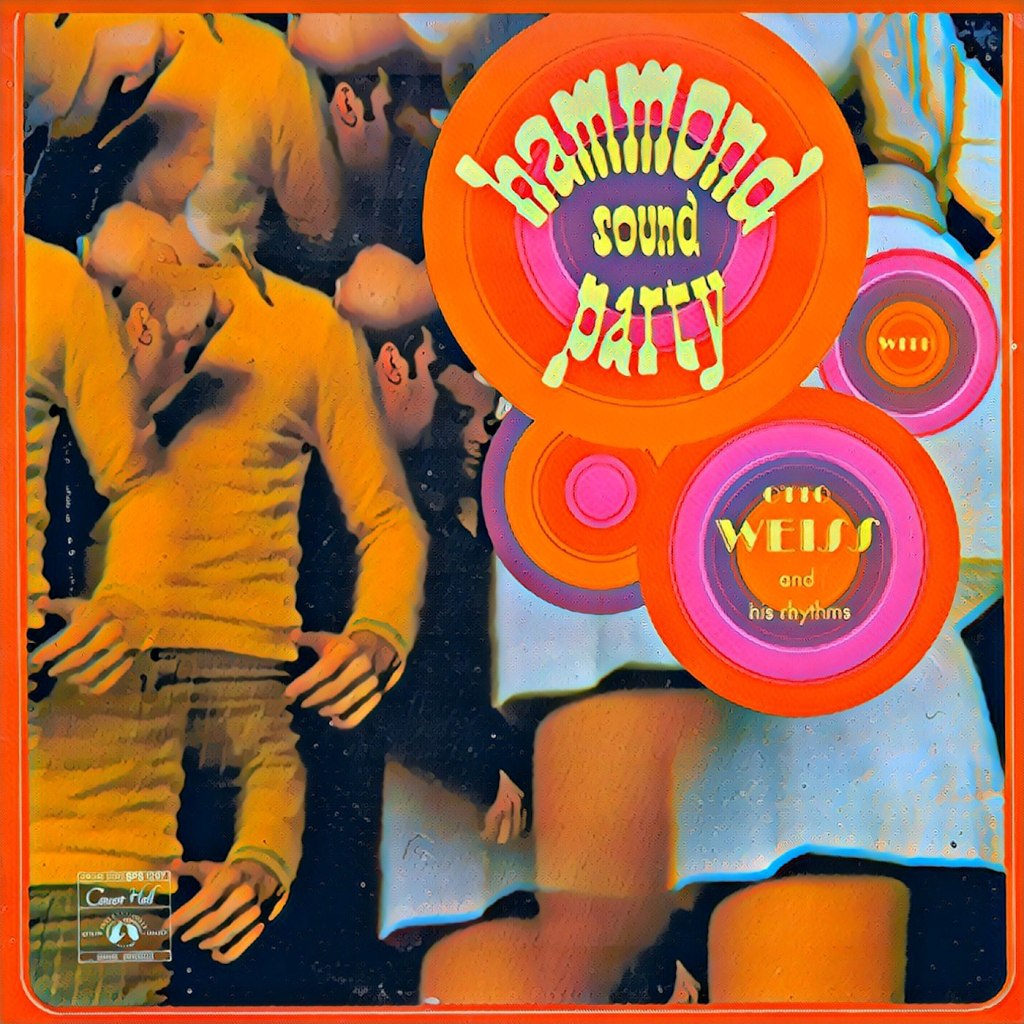
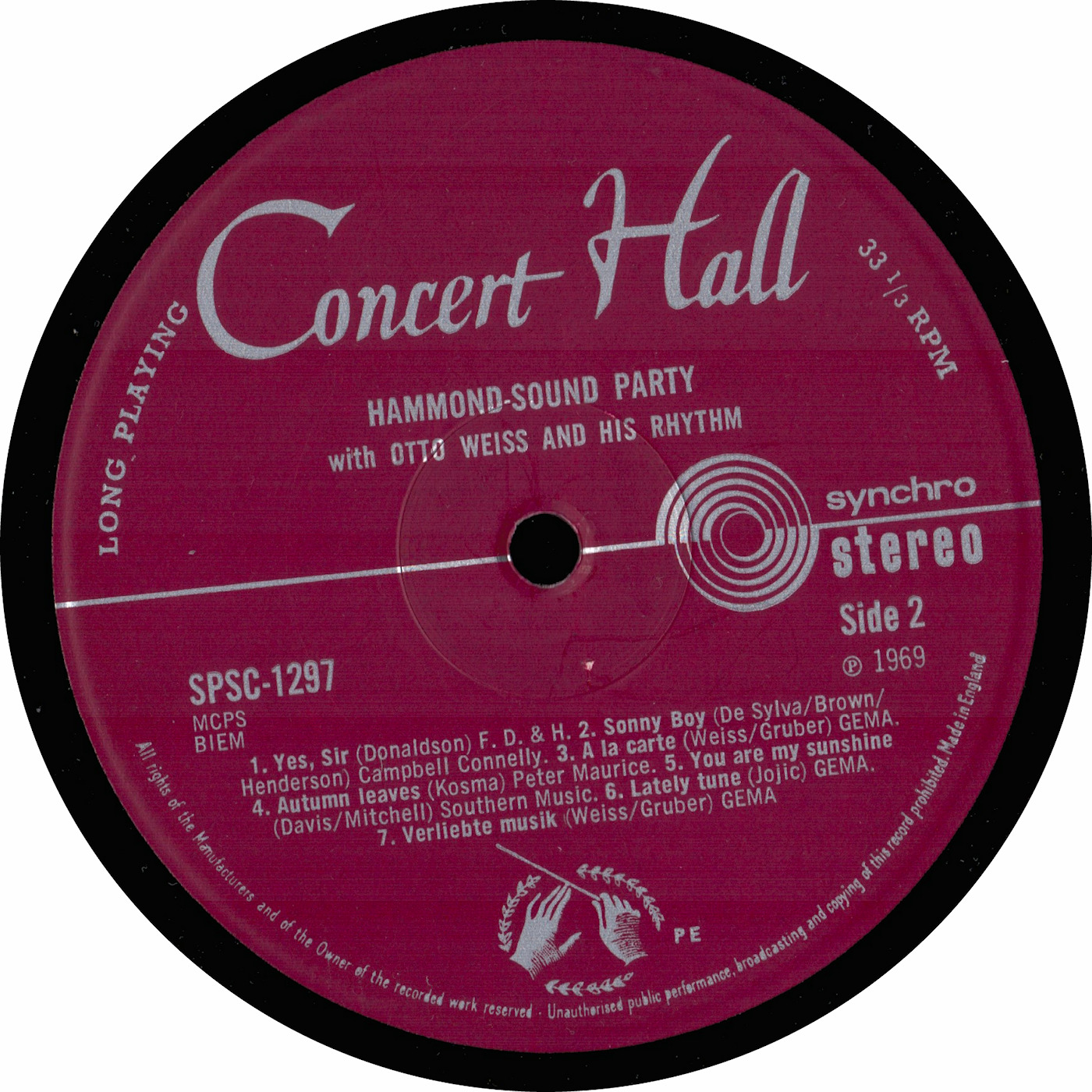
Taken from the LP ‘Hammond Sound Party’ | (Concert Hall SPSC 1297) 1969
In the hands of an expert like Otto Weiss, the Hammond organ is probably the most versatile of all instruments, other, perhaps, than the mighty cinema organs of thirty and more years ago and of which lamentably few are left.
It also has the advantage of being as transportable as an ordinary upright piano. It can imitate successfully the tones of the vast majority of instruments, including even the piano, guitar and other instruments which have no sustaining power; and it also has tone qualities which are peculiarly its own.
Experiments in organ-type instruments which do not depend upon pipes for their source of sound began as early as the turn of the present century, that is to say well before the era of applied electronics.
Hammond Electric Company
In 1935 the Hammond Electric Company of Chicago put on sale the first of their organs without either pipes or wind, and working on the principles of electro-magnetics.
Other firms since have made electronically designed instruments but the Hammond has the inestimable advantage of never needing retuning and requiring the minimum in the way of maintenance and upkeep.
The measure of the Hammond’s immediate success is that in the single month of December 1935 no less than 51 churches in America installed one and during the next two years 3,000 were sold in the United States and more than 100 were exported to England.
Pitch is controlled by a series of discs rotating on a common axle, from 82 upwards according to the size and complexity of the individual instrument.
As the high point of the disc passes in front of an electro-magnet current is induced which produces tone and these tones are then amplified.
The keys permit the sounding of up to eight different pitches, with an almost unlimited number of colour variations. These are controlled by the precise positioning of a bank of eight sliding draw-bars which allow the mixing of fundamentals, octaves, harmonic over-tones and other subtleties at the discretion of the individual player.
Otto Weiss & His Rhythms | A La Carte |
The keys themselves, arranged in piano or organ keyboard style, are really no more than on and off switches. Such are the basic essentials of the Hammond organ.
Not even its makers would claim perfection for it, but the pipe organ itself is not a perfect instrument by a long way. For church purposes the Hammond organ is as if not more effective than a pipe organ costing a great deal more money.
For popular music its versatility makes it suited alike for melody and accompanying purposes. In popular music it is never heard to better advantage than when, as here, played solo, with just a rhythmic accompaniment for bass and percussion.
Otto Weiss exploits the technical possibilities of his Hammond organ to the full, displaying its astonishing range of tone qualities and timbres in a programme which ranges from four of his own compositions and others by his contemporaries back to pieces which first became popular many decades ago.
Narcissus
‘Narcissus’ for example, goes back to the 1890s. It was written by Ethelbert Nevin, a short-lived American composer of songs and light piano music. It was originally written for the piano but over the years has been played on nearly every conceivable instrument and group of instruments. It is presented here in a crisp, rhythmic and hotted-up version.
Donaldson’s ‘Yes, Sir that’s my baby’ was one of the most popular songs of the mid-1920s and De Sylva’s ‘Sonny Boy’ is three or four years later in date and was featured by Al Jolson in “The Siging Fool”, a very early “talkie”.
The more recent pieces range from the richly romantic and sentimental ‘Love-In’ and ‘Autumn Leaves’, through the lilting ‘Du lebst immer noch in mir’ and the virtuosic ‘A la Carte’ to the vigorous and lively ‘Flower Dance’ and ‘Verliebte Musik’.
Here then is music old and new to suit every taste and calculated to display the Hammond organ in all its variety and versatility poised over a rhythm section which never loses for an instant its sensitive and bouncing vitality. (W. A. Chislett)
Any questions and feedback about the material posted on my website let me know by using the contact form provided.
cost of record: £2
from: charity shop

 Junk Box Jury
Leave a comment