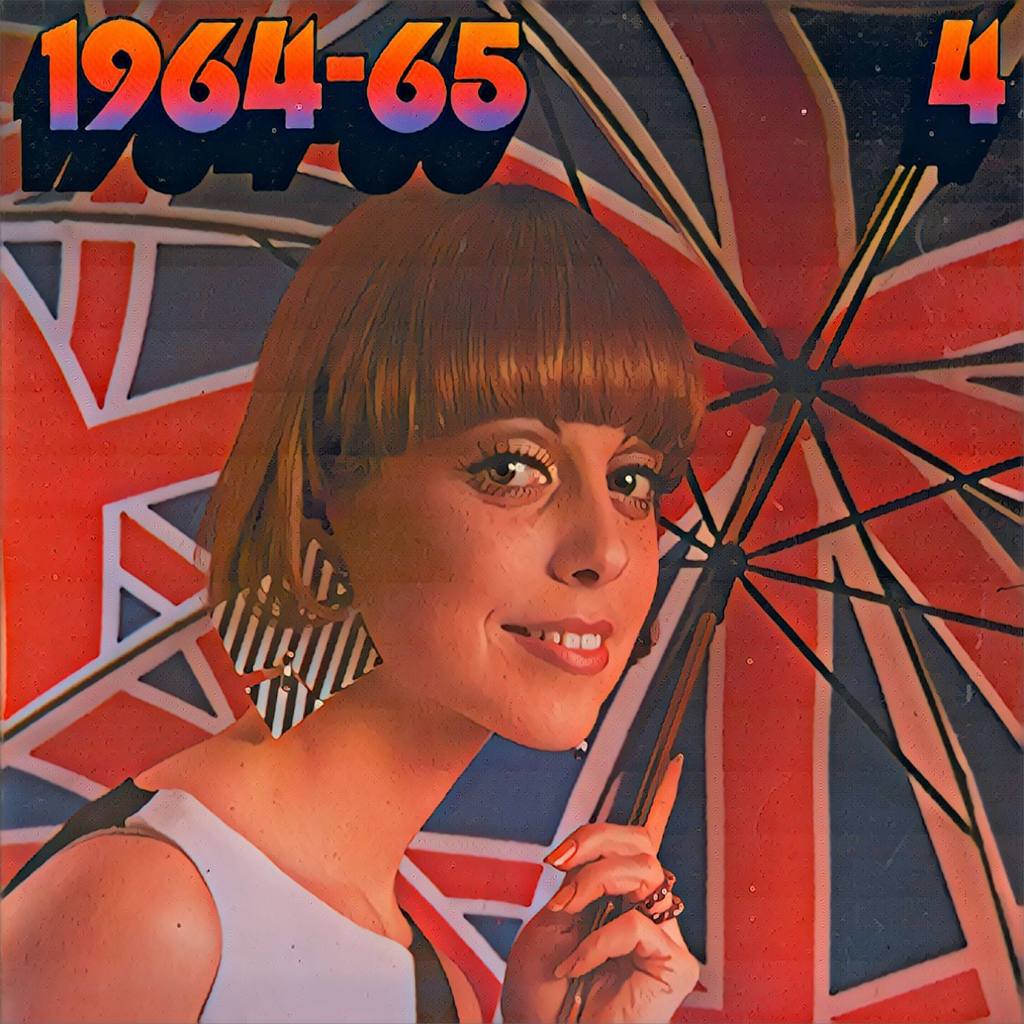
Taken from the LP ‘1964-65’ | (Readers Digest RDS 9034) 1976
This is a stray LP from a box-set released on the Readers Digest label. I found this in a South Shields junk shop but sadly this was the only one of the box left.
I can tell from the album cover that the model is contemporary from the seventies, not authentic to the decade / years it’s supposed to represent. At least half of the tracks have been electronically re-processed for stereo.
Having said all that, the record plays and sounds excellent on my deck and the liners are worth the price of admission alone. The choice singles are detailed below.
“Needles and Pins” | The Searchers | Chart Entry: 25-1-64/Stayed: 9 weeks | Highest Position: 1
Before The Searchers were handed ‘Needles and Pins’ to record — it was to be the ‘A’ side of their fourth single release for Pye — it had been given a delightful treatment by singer Jackie DeShannon.
Written by Americans Sonny Bono — later to achieve international fame as one half of what was a husband-and-wife team, Sonny and Cher —and Jack Nitzsche, it suited the overall sound of The Searchers with admirable ease.
The tremendous success achieved by ‘Needles and Pins’ was slightly offset by the fact that lead singer-bassist Tony Jackson left the group soon after the disc achieved its highest placing.
Certainly, the sudden change in what had appeared to be very stable personnel didn’t affect The Searchers’ fortunes. For the follow-up to ‘Needles and Pins’ — ‘Don’t Throw Your Love Away’ — merely accentuated the astonishing popularity of the Liverpudlians by making it two No. 1 discs in a row.
“Juliet” | The Four Pennies | Chart Entry: 25-4-64/Stayed: 10 weeks | Highest Position: 1
An all-Lancashire band, The Four Pennies reached its peak at the beginning of 1964. Lionel Morton, the Pennies’ leader, played guitar and could also, if the occasion arose, turn his hand to the flute.
Lead guitarist Fritz Fryer was another who wasn’t restricted to just one instrument: he doubled on drums, piano and banjo.
Bassist Mike Wilsh could likewise turn his hand to other instruments; in his case, piano, saxophone and drums.
Only Alan Bush stayed with his first love — the drums. He had worked as percussionist with both Joe Brown and Johnny Kidd before joining his colleagues to complete the line-up of The Four Pennies.
‘Juliet’ — co-composed by three members of the quartet —was far and away the most important recording the Pennies produced. True, subsequently there were three other Four Penny ones which got into the British Top 20 —’I Found Out the Hard Way’, ‘Black Girl’ and ‘Until It’s Time for You To Go’ — but not one of these approached the triumph of ‘Juliet’ in terms of all-round popularity and sales figures.
“You Really Got Me” | The Kinks | Chart Entry: 22-8-64/Stayed: 9 weeks | Highest Position: 1
The Kinks have been so much part-and-parcel of the British pop scene that sometimes their continuing presence tends to be taken for granted. Yet at the same time it is hard to conceive that ‘You Really Got Me’ was a major hit here at the end of the summer of 1964.
Then as now, the driving force behind the success of The Kinks was singer-guitarist-composer Ray Davies. He has always supplied the bulk of The Kinks’ material — with his usual impeccable judgment in writing songs that have some relevance yet at the same time project a definite commercial slant.
‘You Really Got Me’ is pure Ray Davies of the period — less concerned with detail than much of his more recent work. The record itself is much nearer to basic rock ‘n’ roll than The Kinks’ contemporary recordings, and after more than 10 years it still sounds great.
“Always Something There To Remind Me” | Sandie Shaw | Chart Entry: 17-10-64/Stayed: 7 weeks | Highest Position: 1
The team of Bacharach-David remains one of the most important of the entire 1960s’ period. The partnership produced many superior songs during the decade, and most of them were sung with deep feeling by a young discovery of the songwriting pair named Dionne Warwick (who later added an ‘e’ to the end of her surname).
‘Always Something There To Remind Me’ provided Sandie Shaw (formerly Sandra Ann Goodrich) with her first No. 1 hit . . . with only her second record release.
She sings the number in her own special way, adding a touch of youthful innocence to Hal David‘s fine lyric. Some critics — as critics often do — suggested that despite her success, it wouldn’t be long before Ms Shaw was absent from the Hit Parade and forgotten.
Just how wrong she proved them can be gauged from the fact that her follow-up single —’Girl Don’t Come’ — got into the Top Three, and the fourth release, ‘I’ll Stop At Nothing’, went to No. 4.
No doubt at all about her popularity with the public!
“He’s in Town” | The Rockin’ Berries | Chart Entry: 31-10-64/Stayed: 7 weeks | Highest Position: 3
Just to prove that the group scene in 1964 wasn’t going to be dominated completely by Liverpool and, to a lesser extent, London, along came the Birmingham band, The Rockin’ Berries, to pinch some of the Chart glory with a first-class interpretation of yet another winning number from the prolific Goffin-King songwriting team.
It was a just reward for the Berries, as right from their earliest days, they had worked hard on the Midlands circuit playing basic Rhythm and Blues. Then, while touring Britain with P. J. Proby in 1964, they were introduced to Kim Fowley.
He played the Berries an American recording of ‘He’s in Town’ and said the song would suit their style and approach completely. He was right. It became their first and biggest hit.
Today, The Rockin’ Berries are still a top-class group, known as much for their hilarious impressions as their more-serious performances.
“Tired of Waiting for You” | The Kinks | Chart Entry: 30-1-65/Stayed: 7 weeks | Highest Position: 1
Rock ‘n’ roll bands have been formed in a variety of places — in the home of one of the members; over a drink in a pub; or maybe even on a street corner. The Kinks came together at the Lotus House restaurant, London, where they made their first public appearance.
Following the success of their third single — ‘You Really Got Me’—the follow-up — ‘All Day and All of the Night’ — clinched their overall popularity, going to No. 2 in the Charts.
The beautifully felt ‘Tired of Waiting for You’ merely re-emphasised the point that The Kinks were no one-night wonders. The Kinks’ in-person performances were, even in the now far-off days of ‘Tired of Waiting for You’, something special too, with all the fancy gear they sported — innovatory in itself when one thinks of the forthcoming Crazy World of Arthur Brown, Lou Reed, then Bowie, et al. . . .
“Concrete and Clay” | Unit 4+ 2 Chart Entry: 20-3-65/Stayed: 9 weeks | Highest Position: 1
By general consent, Unit 4+2 was one of the very best rock bands to emerge in the 1960s. Sadly, by the end of the decade, they were lost in a deluge of Beatlemania and the popularity of other groups like the Stones, not to mention a hundred-and-one U.S. acts.
But while they were around, this sextet laid down some highly professional music, chock-full of interest, that added much to the British pop scene.
‘Concrete and Clay’ is something of a classic single of the period. The song itself was written by singer-pianist with Unit 4 2, Tommy ‘Sweat’ Moeller and Brian Parker, who fronted the band in its earlier days.
Sometimes there is justice in the world of pop music. And justice was seen to be done at the beginning of 1965 when Concrete and Clay deservedly led the rest of the field as Britain’s top-selling disc.
“Here Comes the Night” | Them | Chart Entry: 3-4-65/Stayed: 8 weeks | Highest Position: 2
Them established a healthy reputation as a vigorous, blues-based rock outfit, with a lead vocalist Van Morrison whose gruff, declamatory style was its individual attraction.
That the band didn’t fulfil its great potential is due as much to behind-the-scenes inconsistencies as to any genuine ill-luck or rejection by a fickle pop public.
Certainly, though, with ‘Here Comes the Night’ — composed by American songwriter-producer Bert Berns, who had already written ‘Hang on Sloopy’ and co-written ‘Twist and Shout’ — they had the world at their feet.
Them came into being as a result of Van Morrison and the others jamming regularly at the Old Sailors’ Maritime Hall in Belfast. They first came to London at the end of ’64, but met with little or no success.
They returned before the year was out and began to make a name for themselves. In January of the following year, their second Decca single — ‘Baby, Please Don’t Go’ — reached the Top Ten in the U.K., and three months later came the tremendous success of ‘Here Comes the Night’.
This, unfortunately, was to be the last time that the Irish band achieved Hit Parade status. In 1966, Morrison left and returned home. He eventually went to the States and is now a solo international star.
“Mr. Tambourine Man” | The Byrds | Chart Entry: 3-7-65/Stayed: 9 weeks | Highest Position: 1
In the early 1960s a young, tousle-headed singer-composer began attracting the attention of the habitués of Greenwich Village, New York. He also played guitar and harmonica. His name — Bob Dylan.
Dylan, who today is recognised as probably the most important songwriter of the past 20 years, came on to the scene with songs of searing, impassioned protest and comment — on international as well as local affairs, about injustice and man’s intolerance of man.
Dylan’s acceptance as a kind of musical spokesman for a generation of predominantly young people opened the way for similarly inclined singer-songwriters.
The Byrds and The Band were the first successful country-influenced rock groups to assimilate the message of Dylan; both still lead today in the field of, what is usually termed, country-rock.
‘Mr. Tambourine Man’ was the top side of the first Byrds’ single for CBS. The Byrds’ sound has always been as pleasurable as it is distinctive, and is personified by this all-time classic, ‘Mr. Tambourine Man’.
“Tossing and Turning” | The Ivy League | Chart Entry: 10-7-65/Stayed: 8 weeks | Highest Position: 3
The Ivy League was said by one writer during the ’60s to be a kind of British Beach Boys. Certainly, there was more than just a superficial resemblance between the trio and their illustrious American counterparts, especially in their use of vocal harmonies and falsetto.
John Carter and Ken Lewis — both from Birmingham — had been members of The Southerners, a band that also included Jimmy Page and Viv Prince, and they had also worked as session singers.
But it was as composers that they were fairly well known, having written ‘Can’t You Hear My Heartbeat?’ for Goldie and The Gingerbreads. The pair teamed up with ex-Bert Weedon keyboard artist Perry Ford to work as a vocal trio at recording sessions — they appeared on The Who‘s ‘Can’t Explain’ — and in 1964 came the decision to form The Ivy League.
The medium-tempo ‘Tossing and Turning’ was an ideal showcase for the vocal-instrumental precision which gave a touch of class to each of their recordings.
Any questions and feedback about the material posted on my website let me know by using the contact form provided.
cost of record: 50p
from: junk shop

 Junk Box Jury
Leave a comment